Rhythmicon.
Four rhythms divide one clock, two four-step sequencers follow them, and the patterns drift against each other until they meet again on the one.
Hear the rhythm. Play it. And finally, see it.
1931
The composer Henry Cowell had a theory: a chord and a rhythm are the same thing at different speeds. A note that vibrates three times while another vibrates twice forms a fifth. Slow both down far enough and you hear a three-against-two rhythm. Cowell asked Léon Theremin to build an instrument that could play this. The result was the Rhythmicon, one of the first electronic rhythm machines: every key played a pulse from the overtone series, the first once per bar, the second twice, the third three times, up to sixteen.
How it works here
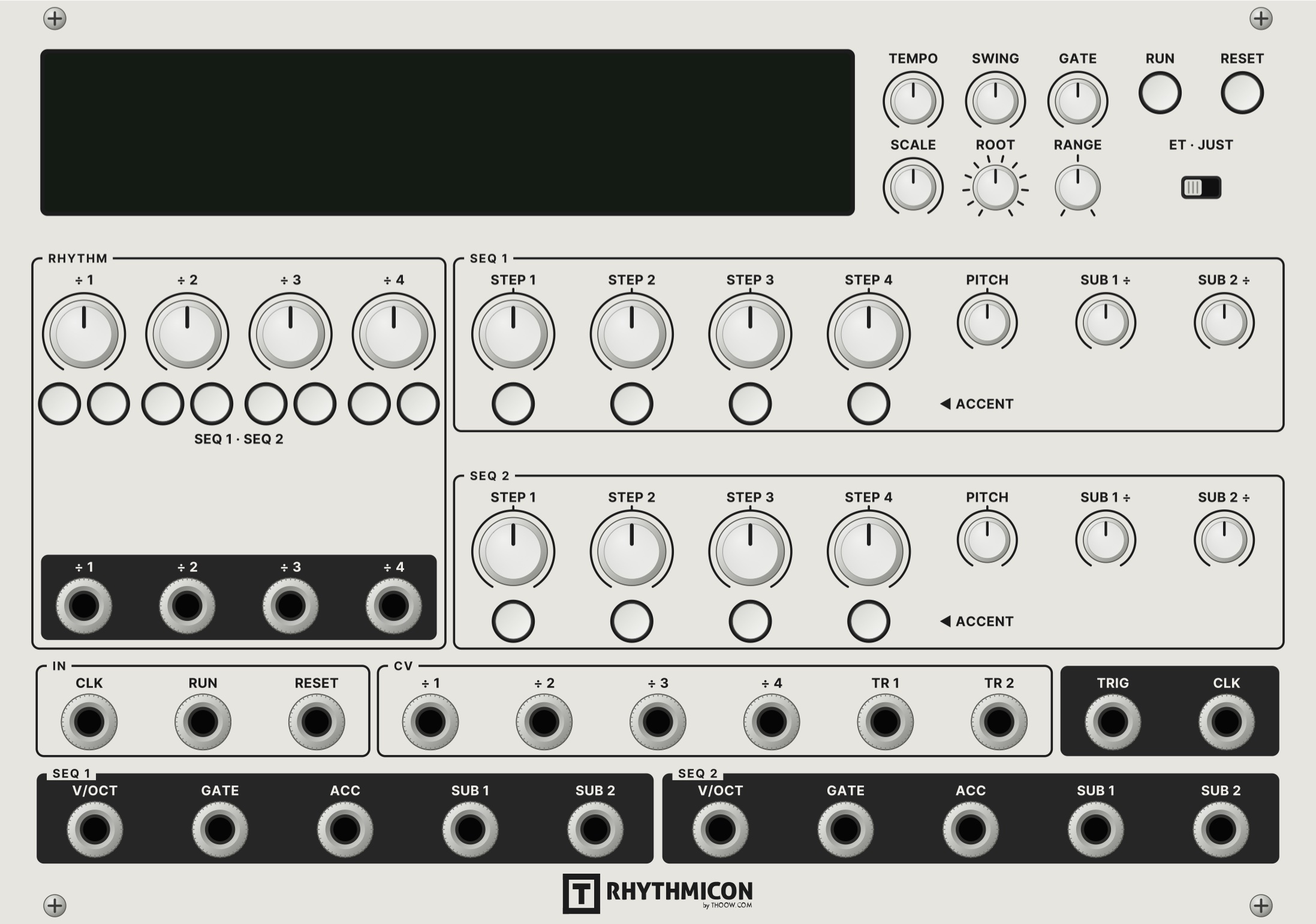
Rhythmicon takes one clock and lets four rhythms divide it by any number from 1 to 16. Each rhythm drives one or both of two four-step sequencers. A sequencer moves on whenever one of its rhythms hits, so ÷3 and ÷4 on the same sequencer make an uneven, swinging line, while the other sequencer drifts at its own pace. The whole pattern repeats only when all rhythms meet again on the one: the display counts that cycle, CYCLE 17 / 42.
Undertones
The same idea works for pitch. Divide a frequency by 2, 3 or 4 and you get the undertone series, the mirror of the overtones. Each sequencer sends its note and two of these undertones as V/OCT, so three oscillators can play a chord that belongs to the rhythm. The same pairing of rhythm divisions and undertones is at the heart of Moog's Subharmonicon: its rhythm generators go back to Cowell and Theremin, its undertones to the Mixtur-Trautonium.
See the polyrhythm
Four rhythm lanes run across the display, with the points where they coincide and the bar where the whole cycle repeats.
Two sequencers, four steps each
Assign any rhythm to either sequencer. Accents per step, swing, internal tempo or external clock.
Subharmonic outputs
Each sequencer also sends its pitch divided by 2 to 16: real undertone chords for three oscillators.
Scales and just intonation
Quantize to a scale and switch to pure 5-limit ratios with one switch.
Questions.
When does Rhythmicon come out, and what will it cost?
Soon. Rhythmicon will be a paid module. Leave your email on this page and we let you know when it is ready.
Does Rhythmicon make sound?
No, it is a sequencer. It sends pitch, gates, accents and undertones as CV. Patch it into oscillators and envelopes, for example three voices of Shapes.
Can I use an external clock?
Yes. Every pulse at CLK is one tick, a sixteenth note. Swing works with the external clock too. RUN and RESET have their own inputs.
What exactly are the SUB outputs?
The note of each sequencer divided by 2 to 16, as V/OCT: real undertones, not rounded to the scale. In the right-click menu you can quantize them to the scale instead.
Is it a Subharmonicon in software?
No. Rhythmicon uses the same old idea of rhythm divisions and undertones, but has no sound engine of its own. Instead it adds a display, accents, swing and 16 scales, and drives any oscillator in your rack.
What does ET · JUST do?
ET is equal temperament as on a piano. JUST tunes the notes of the scale to pure ratios (5-limit), so chords and undertones sound beatless.
Rhythmicon is coming soon.
Leave your email and we'll tell you when it's out.
We send a confirmation link first. Only news about Rhythmicon, unsubscribe anytime.
Paid module. Coming soon.